
🌿 Field Notes #007
Talking to strangers and figuring out thrushes

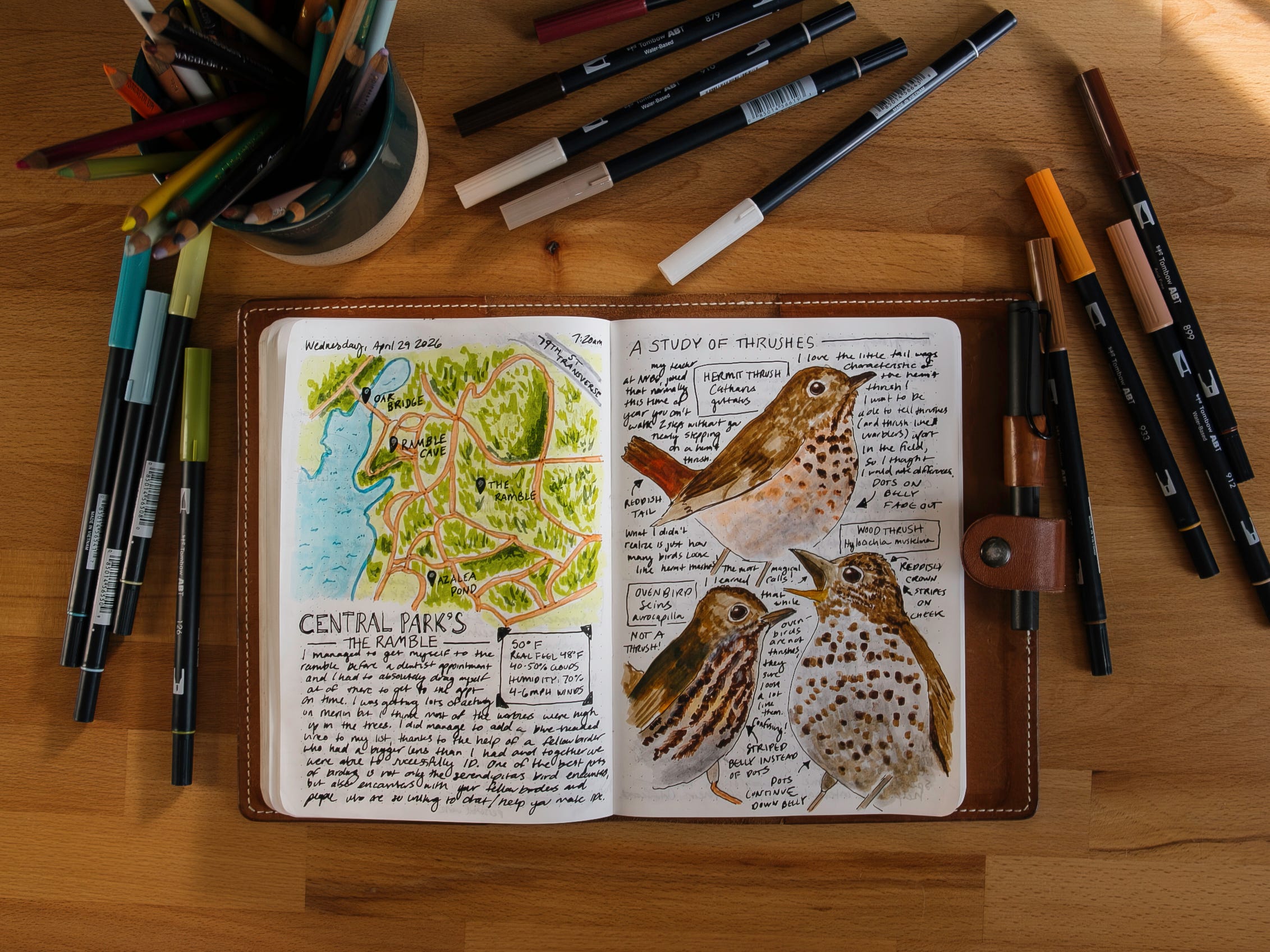
I work a full-time job, and am always envious of the retired birders I meet who get to spend every morning of migration season out in Central Park catching the changes in arrivals by day, instead of by week, like my schedule allows for. My job has nothing to do with birding (well, mostly. I work in research, and like to think that there’s some overlap in a desire to learn through observation and data gathering, at least). All of this to say that I need to fit in birding wherever I can, particularly during migration season where every morning not spent birding feels like a morning I’m missing out on.
This past week I had an early morning dentist appointment off of the C train, and used the opportunity to go to Central Park’s ramble early to get some birding in before returning to work after my appointment. While I’m there for the birds, I had a number of lovely interactions with fellow birders:
A man asked if I was looking at the Northern waterthrush (I was) and if there was anything else by the lake he’d missed (only a double-crested cormorant for me so far)
Another man was planted across from the Azalea pond from me, trained on a palm warbler, and stayed put until I could make my way to his side to see it
I walked passed a birding father pushing a toddler in a stroller who had a tiny camera of his own. The toddler saw my camera and yelled out to me, “This is MY camera! It takes pictures of BIG birds!”
I was watching a vireo for a bit and couldn’t quite make out if it was blue-headed or red-eyed, because I was mostly watching from directly below. There was a woman also watching it with a larger lens than mine, so I asked her if she could tell. She was leaning towards red-eyed, but I mentioned that Merlin kept picking up a blue-headed, until she managed to capture a shot of the side of the bird and confirmed blue-headed for the both of us.
As I was leaving the park, an excitable group of older men with the largest lenses I’ve ever seen were heading to the ramble. They stopped and asked if I had been in there birding, and when I told them yes, they asked what they needed to see. I had just passed a black-and-white warbler (truly striking warblers but fairly common/easy to spot this time of year), so I pointed out where it was, and they acted as if I had told them I’d seen a painted bunting (there’s been one recorded in NYC but it was very far off track). I hope that I remain this excited about black-and-white warblers even after many years of birding, like these men seemed to be.
I am an introvert by nature, but chatting with birders in the park comes easy to me. To work together with a stranger to identify the differences between a red-eyed and blue-headed vireo is to come to an implicit understanding that we are lucky to occupy this moment on this planet with this particular winged creature, and that this feeling of gratitude holds enough shared value to transcend the fact that we’ve only just met.
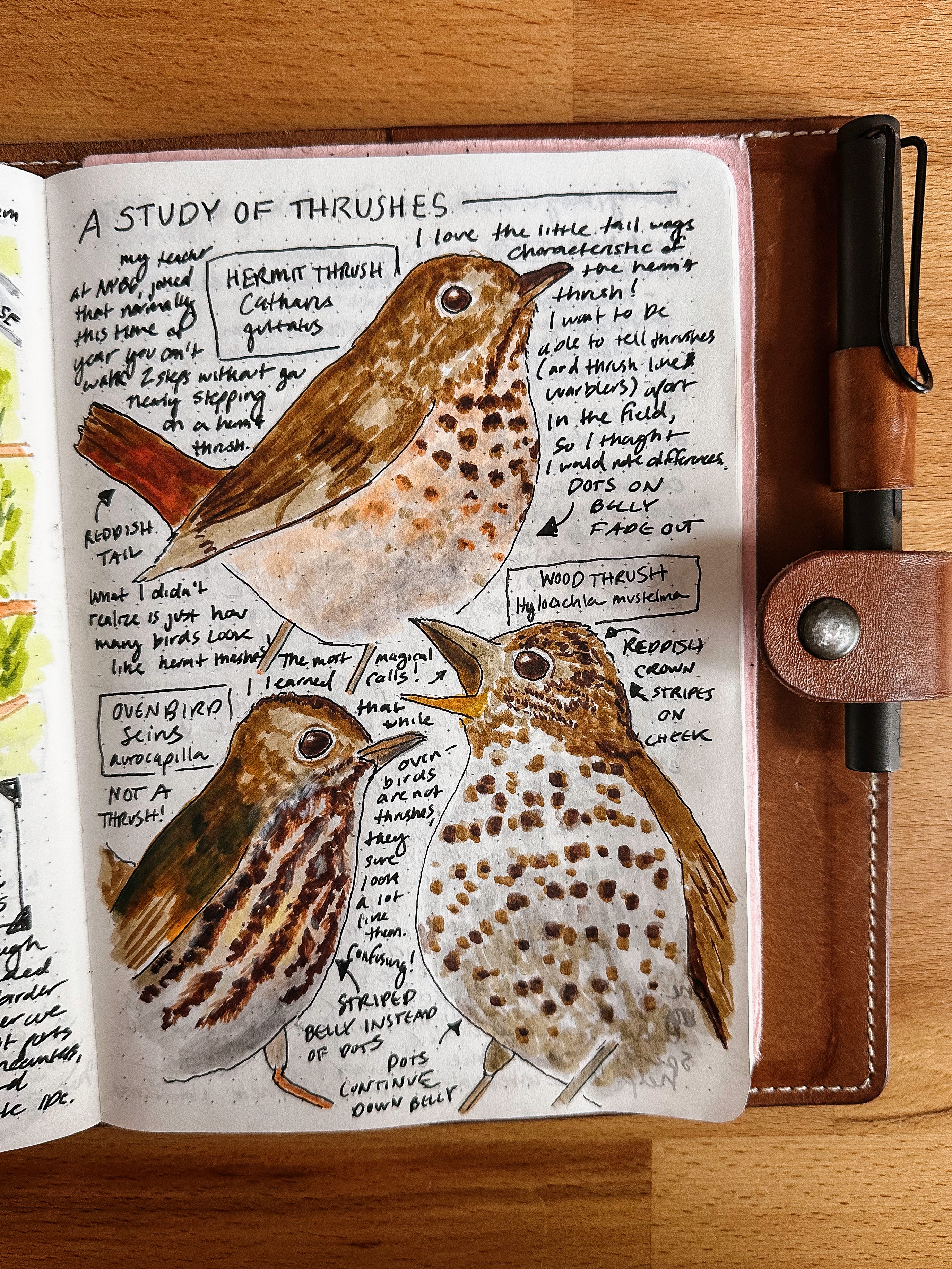
One other identification I found myself struggling with was with thrushes (and ovenbirds, which are not thrushes, but do look like them), so I thought that spending some time drawing them might help me internalize some of their differences. I learned they are actually quite different: hermit thrushes have a distinct red bobbing tail, wood thrushes have dots that run all the way down their bellies, and ovenbirds are smaller with dots that converge into stripes:
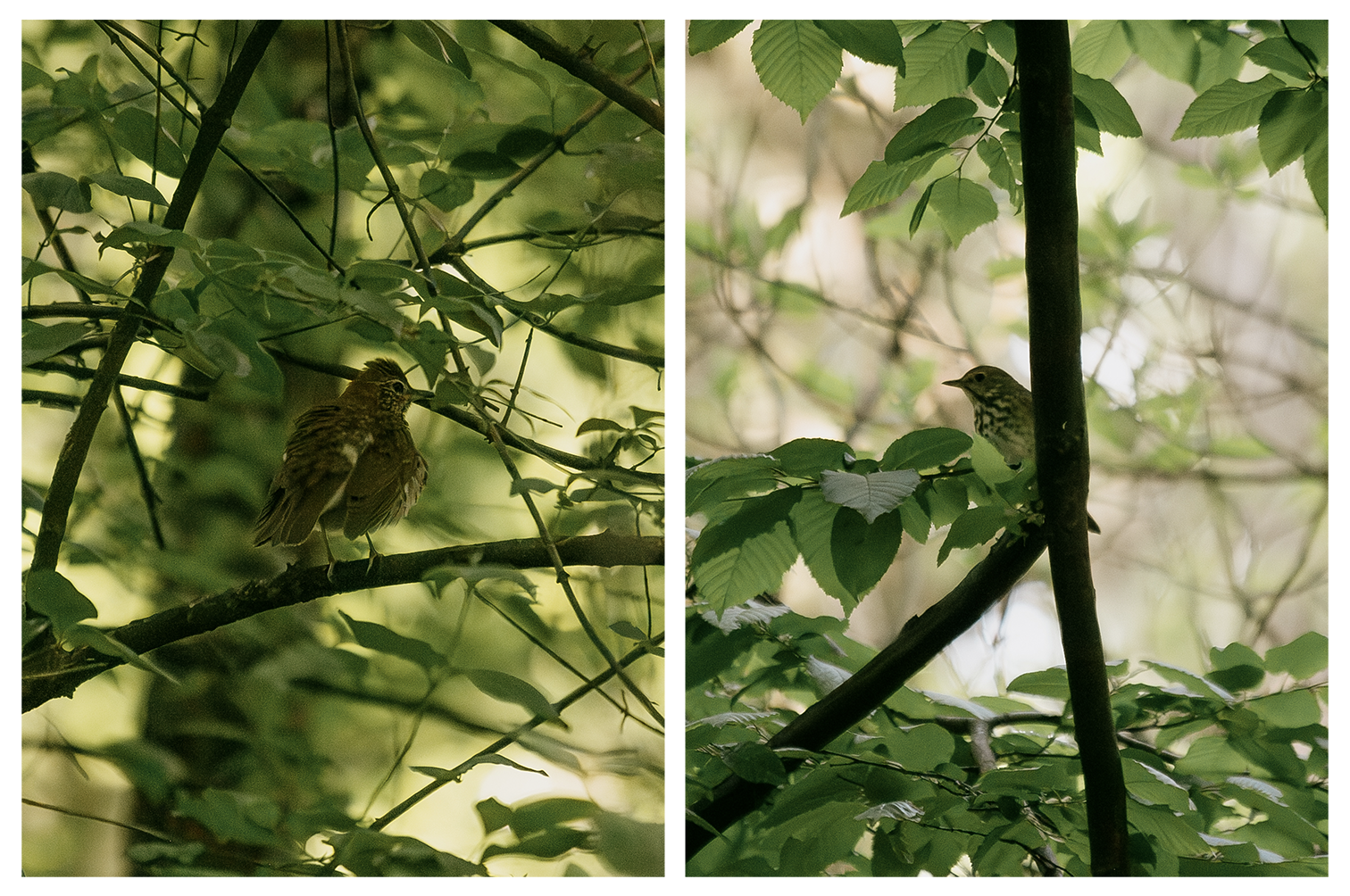
I have been particularly grateful to birding lately for its ability to wholly capture my attention unlike many other things in the modern world. It is depressing to think that birding feels somewhat radical to me lately, like offering my time and attention (an extremely valuable commodity in current times) to birds seems inherently anti-capitalist and pro-environmental. The birds will not be making money from my attention, and submitting my accurate eBird list like a good citizen scientist can help contribute to conservation research. To spend my time figuring out which thrushes are which is to believe that their differences matter, that these differences should be preserved, that I wish to pay attention to that which I want to know deeply, and that when I am choosing to know the earth better I am also choosing to know my own place in it.
If you have the time this weekend, I hope you get to spend some time outside paying attention. It is always surprising and rewarding, and an incredible reminder of how lucky we are to occupy the same planet as a bird or a stranger or a tree.
What a lovely post, Cara! We only have two thrushes out here in Oregon so it’s much easier to tell them apart. I miss Wood Thrushes, though, with their ethereal voices. Looking forward to more of your posts!
Gorgeous nature journal. I found myself talking birds to my regular grocery delivery driver the other day - he's been coming for over a year but I never knew he was a birder as well! We both just lit up talking birds, was lovely. Glad a couple of women were out in your park - birding still seems to be a male dominated interest unfortunately.