

One twig at a time
The optimism of birds' nests, and why they captivate us

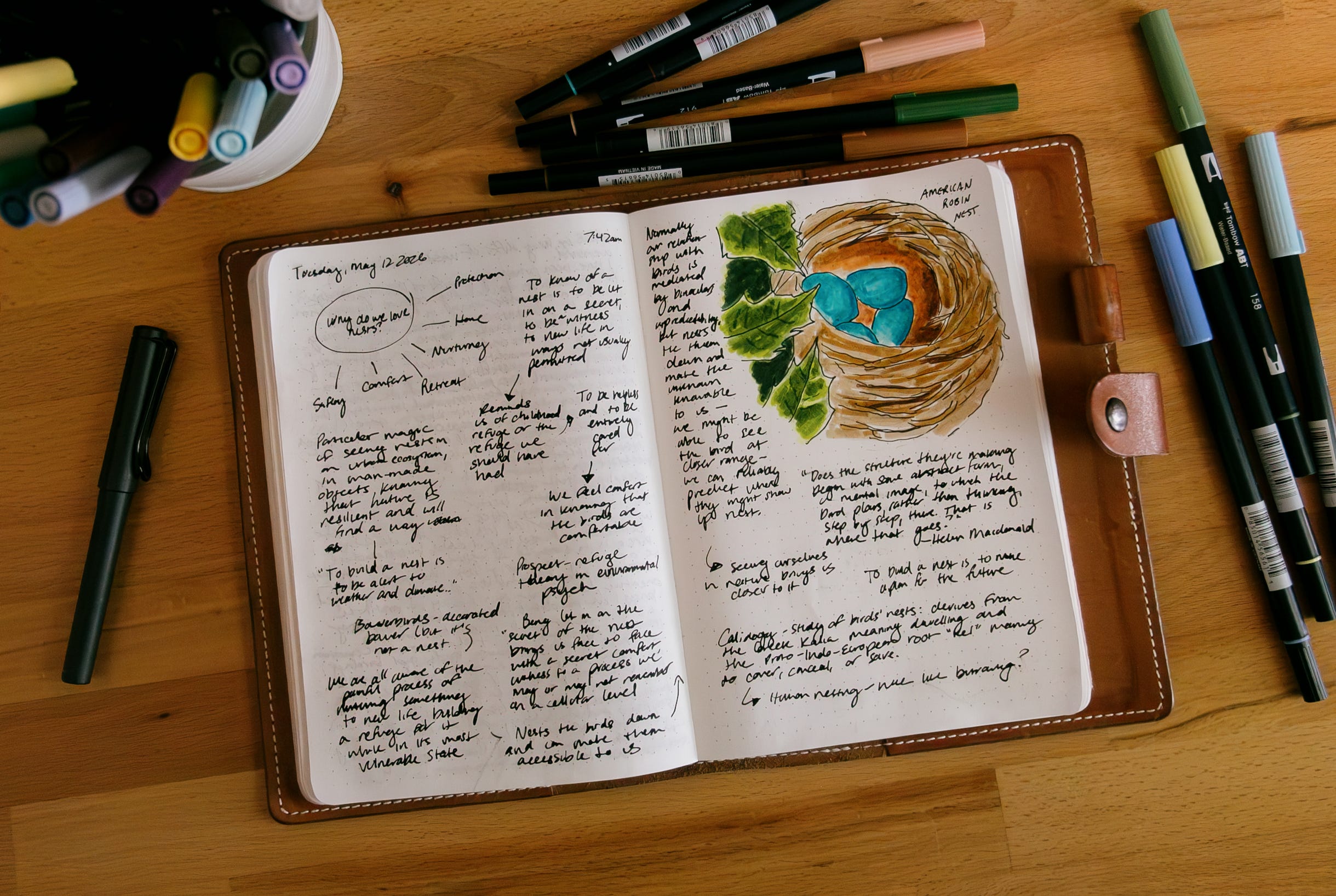
There’s something about birds’ nests that captivates even those without much of a true interest in birds; it feels like they activate something primal in us, like something returning us to childhood. Peering over branches to the sight of chirping babies or a fluffed up mother bird atop a cupped dwelling of her own design feels like being let in on a secret, becoming privy to something that is normally hidden and unfamiliar to us, which makes us want to know more.
For children, woods and fields and gardens are full of discrete, magical places: tunnels and dens and refuges in which you can hide and feel safe. I knew, when I was small, what nests were about. They were secrets.
Helen Macdonald, The Forbidden Wonder of Birds’ Nests and Eggs
For those of us who were lucky enough to be able to spend time (particularly unsupervised) outdoors as children, the image of nests conjures up memories of broken blue eggs or abandoned nests in the fall, which were usually the only evidence I managed to locate that a nest existed in my yard at all. Very occasionally would we find one still active, and being let in on the secret of the nest brought me face to face with a scene that activated a fundamental comfort: to simultaneously be entirely vulnerable and entirely cared for.1
This wonder is lasting, and today when we discover a nest it takes us back to our childhood or, rather, to a childhood; to the childhoods we should have had. For not many of us have been endowed by life with the full measure of its cosmic implications.2
I still retain (like I think most people do) a sense of wonder when I stumble upon an active nest. Normally, our relationship with birds is mediated by distance, binoculars and a certain unpredictability, and there is no guarantee a bird we spot one day will be in the same place the next. Nests tie birds down and make the unknown knowable to us. We might be able to see the bird at closer range, and we can reliably predict that they will continue to be there until their babies have fledged. If we are particularly lucky, we may have located the nest because we spotted the birds building it in the first place.
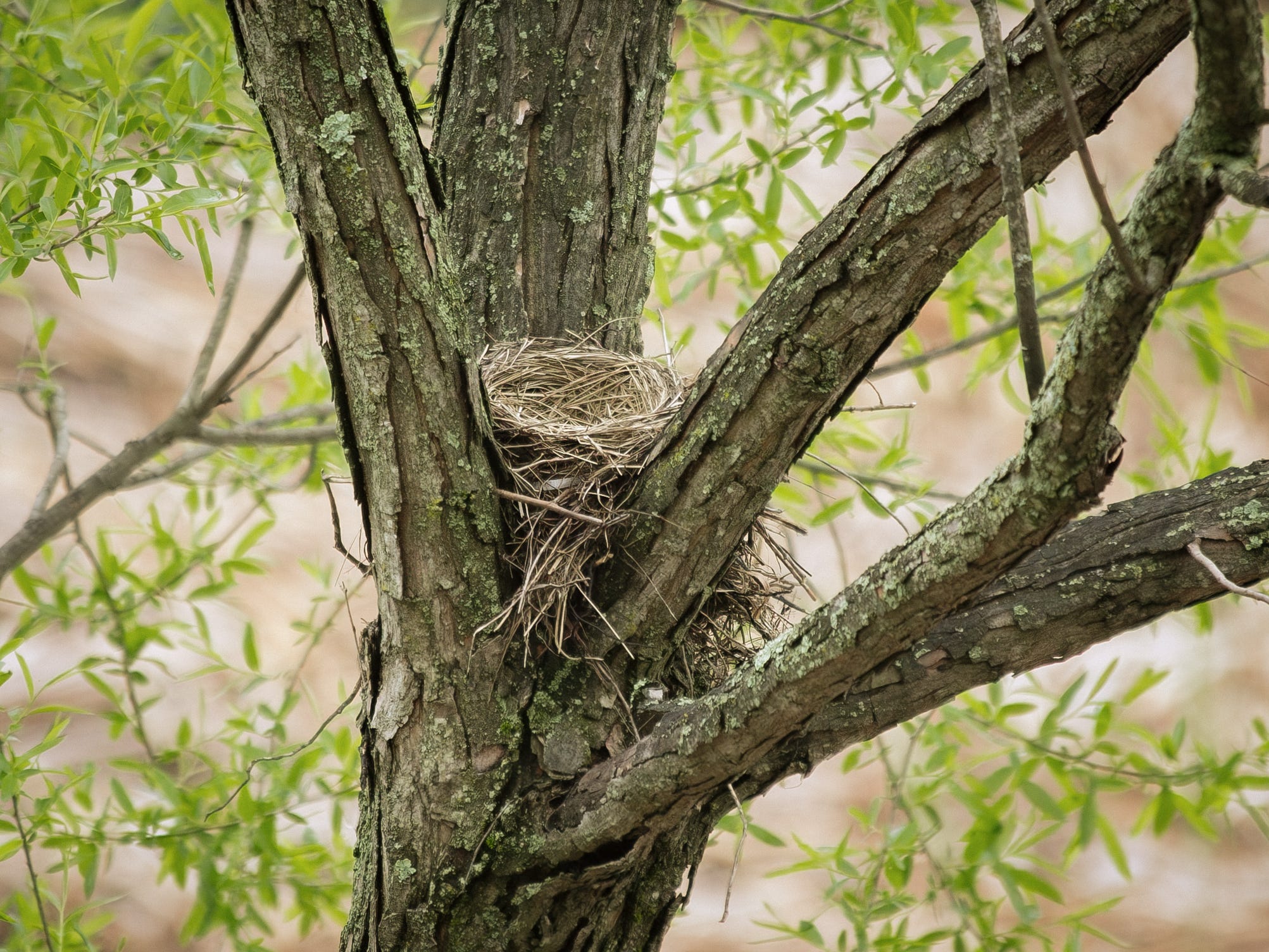
And so when we examine a nest, we place ourselves at the origin of confidence in the world, we receive a beginning of confidence, an urge toward cosmic confidence. Would a bird build its nest if it did not have its instinct for confidence in the world?
Gaston Bachelard, The Poetics of Space
To make a plan is inherently optimistic, so to build a nest an act of optimism. The eggs will hatch, the young will survive, they will fledge to begin their own lives. I resonate equally with the premise a bird knows what the nest will look like at the outset or whether it simply knows it needs to start with one twig and trust that it will figure out what to do with the next one as it comes. I too have done both: began with a fully-realized plan that came to fruition, and decided I needed to start somewhere and would figure out the rest one thing at a time. The latter scenario has definitely become more likely as I grow older and realize the futility of planning, though I still can’t help but make them.
Do birds plan like us, or think like us, or really know how to make knots, or slap beaks full of mud in series, or is this merely instinct? Does the structure they’re making begin with some abstract form, a mental image, to which the bird plans, rather than thinking, step by step, there. That is where that goes?3
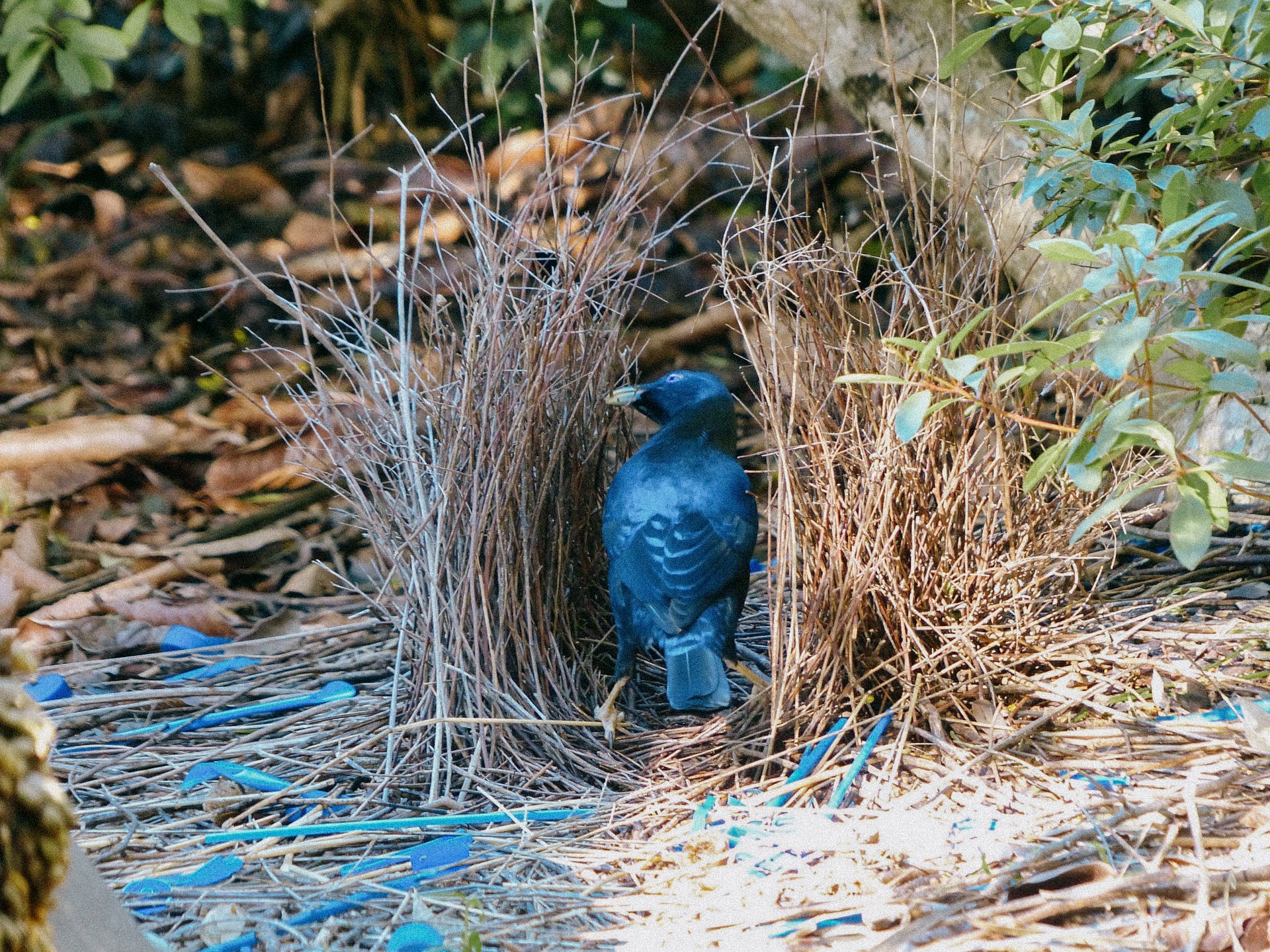
I also think about how we are especially captivated when a nest has utilized things that belong to humans, whether it is twine, or wire, or the cliff’s edge of an old building. The male bowerbird builds a bower to entice its mate, and the satin bowerbird in particular adorns its bower with often manmade blue items like bottle caps and plastic straws. In some ways, watching a bird utilizing our trash is depressing, but in other ways it reminds me of the miracle of our coexistence. The earth has existed for billions of years and is just one planet amongst incomprehensible planets within trillions of galaxies, and I get to live at the same time and the same place as a little winged creature who wants to decorate its altar of seduction with tiny blue bottle caps. While many of us are constantly aware of the many organisms we share the earth with and how our actions affect them, the bird’s nest that incorporates our discarded plastic is still a disquieting reminder that we are not considering them enough.
Perhaps...it is also about testing the edges of a space, teasing its limits – bringing a careful attention to our environments, and how we inhabit them, and learning how to demand a world that is safe and hospitable to all.4
The nest, ultimately, dredges up our own secrets: how we felt about our childhoods, whether we are hopeful for the future, if we can see our plans through, and if we care enough about our planet that our birds don’t have to clean up our messes for us.
Bachelard, Gaston, and M. Jolas. The Poetics of Space. Beacon Press, 1994.
Bachelard and Jolas, The Poetics of Space.
Macdonald, Helen. “Helen Macdonald: The Forbidden Wonder of Birds’ Nests and Eggs.” Books. The Guardian, September 9, 2017. https://www.theguardian.com/books/2017/sep/09/helen-macdonald-birds-nests-eggs.
“In a Changing World, Nests Remain a Site of Safety and Nurture | Aeon Essays.” Accessed May 15, 2026. https://aeon.co/essays/in-a-changing-world-nests-remain-a-site-of-safety-and-nurture.
Thank you for this sweet essay!
A bird nest is like a little stanza: it's own room of wonder and life. It's a home that can take awhile to build, but we innately want to create it!
This was beautiful. I also am fascinated by birds and their nests. Thank you for this post.